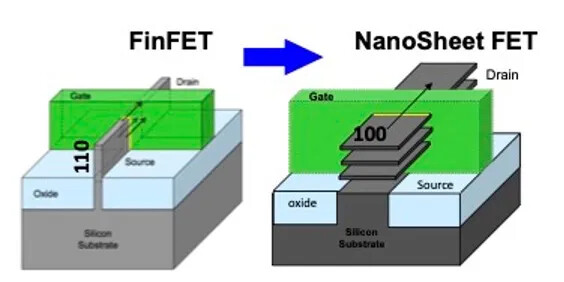
IBM, during the 2023 IEEE International Electron Device Meeting (IEDM), showcased a nanosheet transistor concept that achieves nearly 100% performance improvement at the boiling point of nitrogen, which is 77 Kelvin (-196 °C). This breakthrough has the potential to unlock a new category of chips that can deliver top performance when cooled with liquid nitrogen. Imagine a new generation of AI HPC accelerators that can instantly double their performance with LN2, provided a suitable cooling solution is developed for data centers.
Nanosheet transistors are the next evolutionary step after FinFETs, which have been the driving force behind semiconductor foundries since the 16 nm process node. However, FinFETs may reach their technical limits at 3 nm. Nanosheets are expected to make their debut with 2 nm-class nodes like the TSMC N2 and Intel 20A. IBM's nanosheet device, operating at a temperature of 77 K, is claimed to offer nearly double the performance by reducing charge carrier scattering, resulting in lower power consumption. This reduction in scattering also decreases resistance in the wires, allowing electrons to move faster through the device. Combined with lower power, this enables devices to drive a higher current at a given voltage. Cooling further enhances the sensitivity between the device's on and off positions, reducing the power required to switch between the two states. As a result, power consumption is reduced. This lower power consumption allows for narrower transistor widths, leading to higher transistor densities or smaller chips. Currently, IBM is facing a technical challenge related to the transistor's threshold voltage, which is necessary to establish a conducting channel between the source and the drain.